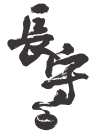

1.
After he stopped teaching classical Chinese, Father became the keeper of a reservoir.
His hair was untidy, his stubble blue-black; he was small, thin and slightly stooped. At the university his colleagues called him Little Dong. He did not seem gifted at teaching. When a student asked a difficult question, he would fall silent as chalk dust circled in the sunlight on the blackboard. Slowly he would turn away and continue writing, leaving the student to sit down in embarrassment. Father did not take attendance. By the second half of term, few people came to his classes. He was unlike Mother, whose students visited on holidays carrying gifts: cans of Wangzai milk, Nescafé, fruit baskets, ejiao blood-tonic granules and Taitai oral tonic.
Mother looked young, with short hair, a plump figure, pale skin, a lovely flush in her cheeks and eyes like deep water. People respectfully called her Teacher Li. Her field was teaching Chinese as a foreign language. When she was applying for graduate study, several supervisors wanted her, and each came to our home in turn to talk.
We used energy-saving incandescent bulbs that made the white walls look whiter still. Sometimes Father came out of the bedroom and smoked in the living room—five-yuan Baisha cigarettes. Under that light, the smoke rolled and folded near the ceiling like July storm clouds holding halos and thunder.
The university stood on the outskirts of town and only one bus reached it. Many people nearby had moved in from the countryside. Houses rose wherever they could, and children did not go to school. Those children were dark-skinned and sharp-eyed; when school let out, they hid in the alleys to demand money from us. A long concrete wall encircled the campus, its top set with broken glass, and beyond it grew a disorderly wood. On weekends Father took me burrowing through those trees. Thorns scratched my face. Mother, resting in bed, saw the cuts and sighed: ‘I ask you to look after him for one day and you can’t even manage that.’
2.
Gaofeng Lake had once been only a small pool where streams met. Then a hydropower station was built downstream; the dam stopped the river and the water rose. Diamond-shaped concrete blocks covered the dam’s slope, slick with moss near the water. In summer rains the gates opened and white spray burst through. Two rivers fed the lake. Upstream lay wetlands hidden by dense reeds, with several fallen trunks barring the channels. The water was yellow by the shore. A few water striders skated on long legs. Towards the centre it grew greener, deepest green at the deepest point, as though a cave lay below. You could not help staring, as at the edge of a nightmare in the middle of the night.
Plants crowded the banks: mainly evergreen pines, but also firs, chestnuts, low rhododendrons and masses of beggar-ticks. A blue sign read GAOFENG RESERVOIR. At the junction on the road down stood a white building, the keeper’s cottage. Father lived in that room for almost two years.
Two months after taking charge, Father decided to build a camp beside the lake. Soon there would be barbecues and camping as well as fishing. Army-green tents went up; stones ringed a firepit filled with fine white ash. He bought woodworking tools in the county town, sawed dead trees and split firewood. He repaired the old wooden boat, covering its largest holes with sheet metal. Water seeped between some boards, but overall it sat steadily on the lake. He made a pair of oars from hard fir.
News travelled quickly. The water bureau sent people to inspect. Wearing camouflage, they fished beside the lake and grilled their catch. Father tended the fire and made soup, offered them several cans of beer, and slipped a pack of soft-pack Baisha cigarettes to the man who seemed to be in charge. Near dusk they drove down the mountain without saying clearly what they thought of the camp.
Soon more and more people came to fish—from the county, from nearby villages, even holidaymakers from far away. Most were patient and did not disturb one another, flicking bright lines back and forth through the air with the whistle of wind. A beginner’s fishing rod appeared in Father’s room, leaning against the window, new enough to shine.

Watching Boats by the Lake · Photographs by Luo Bo
3.
At first we lived in staff housing. University salaries were low then, and so was our standard of living. The residence was a long, narrow corridor with doors facing one another. Our room held a bed and a writing desk. To eat, we carried a folding table into the corridor. The kitchen, toilet and shower were communal, at the far end, where light entered through a large window and dust drifted in a dim tunnel of time.
Father and Mother began graduate school together, but by the time Mother started her doctorate, Father had only just completed his master’s. He rarely shut himself in a room to write papers as she did. He liked calligraphy, practising Qian Kun boxing, and sleeping.
One morning he went to the canteen for breakfast while Mother and I were still in bed. Suddenly the door was kicked in. I saw the doorboard fall towards the bed. Father stepped across it, climbed onto the bed, seized Mother by the hair and drove his fist down again and again, solidly and fast.
Later I asked Mother, ‘Why did he hit you?’
‘How would I know? Maybe the lock broke and he thought I had bolted it from inside to keep him out,’ she said, as baffled as I was.
Mother also said the staff room was so small and oppressive that it helped make him quick to rage. When the university allocated us an apartment, she threw herself into the renovation. After every class she hurried to the site and supervised the workers fitting out our new two-bedroom home. The bathroom had a red-painted concrete floor; the living room had white tiles printed with blue flowers. There was a semi-circular arched entrance, stainless-steel security bars, ribbed frosted glass and a bright balcony opening onto camphor trees. After we moved, Mother even hummed while washing clothes, rubbing them noisily on the balcony.
The university waived most of the purchase cost. For what remained, they looked actively for a solution. At weekends I saw them sitting shoulder to shoulder on the bed, waiting for the Double Colour Ball lottery numbers. On the fourteen-inch colour television, a host in a suit built suspense. The balls fell into place; hope remained for next week, and the week after. One sweet dream followed another.

Watching Boats by the Lake · Photographs by Luo Bo
4.
In the morning mist rose from the lake, supple and downy. Sunlight came thinly, loosely, bestowed a little at a time. We got up and hung the sleeping mats and quilts, damp from the night, over the tents to dry. With bamboo baskets on our backs, we went into the pine wood for fallen branches and cones. Father carried a short axe and a one-handed saw. When he found a large dead pine, he cut its trunk into rounds, hacked away the unruly branches, tied the wood with rope and dragged it back to camp.
Near sunset we lit the firepit. First we stacked pinecones and fine twigs for kindling, then laid on logs thicker than an arm. Flame gnawed at splintered edges and dry needles. It went out several times. At last the moisture left the big logs and a great body of fire rose from the stones.
After cooking, we washed beside the fire. When the flames were spent, fragments of charcoal snapped and glowed, brightening and dimming like breath. Leaning close, you could still feel their heat and smell the choking pine smoke.
At night I sometimes tried rowing. Mist filled the lake until the surface seemed solid. Wind churned it like a blizzard racing and howling, and the little boat travelled through an endless snowfield.
Father stood on shore holding a torch. Its beam opened through the mist and guided me towards clear water. The boat passed through a bank of fog and the night sky appeared, with a few careless stars. The oars struck and lifted. I heard the surface trembling, birds calling, wind crossing the pines, and blood moving in the vessels behind my ears.
5.
The new home soon lost its magic. One day they argued about smoking again. Mother told him to finish his cigarette in the stairwell before coming in; he answered by slapping her. I watched a jar of glass marbles fall from the refrigerator. Coloured balls struck the newly laid tiles, bouncing and clattering in every direction. This was our life exactly: no one knew where it had begun, still less how to make it stop.
Father missed more and more classes, and his violence worsened. At last Mother took me away. We rented a room at the other end of the campus. She bought a cheap pressure cooker and everything needed to make up a bed. I expected we would not return home for a long time. Yet the next evening Father found our door. He stood outside for a while and said in a low, hoarse voice, ‘I can’t find the bath towel.’
My aunt came from our home village, a three-day journey by bus, carrying a magnificent rooster with a fiery comb and bright feathers in a woven plastic sack. In front of us she scolded Father fiercely. His face softened into a sheepish smile, touched by unease and guilt.
They took me to skim stones at the pond in front of the teaching building. The building was old red brick covered in vines. Outside its wall were two empty plots, each with a great pine like a pointed tower, and the pond lay beside them. We picked shards of porcelain and smooth stones from the foot of the wall. One shard bounced three times, struck the wall opposite and shattered. My aunt was a clever, plump woman. For several days the swaggering rooster stalked our cramped kitchen and shat everywhere, until one night it was silently killed. After my aunt left, our home quickly returned to its former uproar.
Father slept too much and flew into rages. He no longer rose in a singlet to practise boxing. A cover lay over his calligraphy copybook; the inkstone dried to a blue-grey. Because he was absent so often, university leaders came twice. Father brought out a little white porcelain jar containing Biluochun he normally saved. After they had spoken for a while, the leaders’ faces darkened. When they returned to campus, they removed the desk from his office. The university did not like dismissing people; it merely withheld his teaching pay while continuing his basic monthly salary. Feeling humiliated, he went to the academic office and pounded the table. He threatened to burn the teaching building, said he was mentally ill and therefore could not be held legally responsible for killing anyone, and fought with two security guards who rushed in.
The divorce took six months to reach judgment. Unexpectedly, the first court awarded Father custody of me. Through connections he had already found a new job and, I heard, was living beside a lake. This meant leaving Mother, moving house and changing school. It meant a multitude of enormous impossibilities.
While packing, I saw half a pack of Baisha cigarettes in Father’s drawer and a calligraphy book. Inside was a piece he had copied, crooked and difficult to read: ‘Flower-scent presses hard against my meditation; / my state of mind has truly passed middle age. / What shape do spring thoughts take? / A boat fighting upstream at Bajie Rapids.’
That spring Deng Xiaoping died and mourning spread across the country. Late at night people walked beneath white xenon lights carrying elegiac couplets and funeral wreaths. That summer Hong Kong returned to China: grand processions on television, magnificent floats, salutes that shook the sky, aircraft trailing coloured smoke.
One of Mother’s students was a lawyer. He said there was a good chance the judgment would be reversed on appeal, and then she could bring me home. Before I left, Mother took me to the largest department store in the city and bought the newest Japanese game console. As our bus passed through an underpass, the day turned impossibly dark. The driver slowed and switched on the headlights. In the grey atmosphere, vehicles seemed like deep-sea fish flashing their scales. We were seeing a total solar eclipse said to come once in twenty-five hundred years.

Watching Boats by the Lake · Photographs by Luo Bo
6.
The lakeside camp was dismantled, and with it Father’s hope of beginning again. He looked thinner and more withered. Cobwebs gathered on the fishing rod, which was never used after all. At last the court reversed its decision. I was overjoyed to be going home, but did not know how to say goodbye. From the car I saw Father in the distance, squatting at the end of the road and breaking a twig. The car jolted, coughed a little black exhaust, and carried us farther and farther apart.
After a dry season, Gaofeng Lake seemed to have shrunk. In the sun, seen high among slopes and trees, it looked like a sheet of silver foil trampled again and again. Clinging to the dusty window, I turned back to look and knew I would never return. The lake and Father together would pass out of notice—out of our memories, out of a world filled with grand narratives.
At the end of the following year, my aunt called. Father had not returned to the village for New Year. They went to the reservoir and found his clothes but not him, so they called the police. The lake was drained. The mud on its floor was fine and soft; scoop up a handful and it slipped through your fingers, red with a little gold. Local people came with buckets to take it away. They said it was the best earth for growing plants: look at the trees beside the lake, how tall and straight they are.
24 November 2021