A complete English translation of the original Chinese journal published by Changshou. The original numbering jumps from 126 to 129; that numbering has been preserved.
2023—2024
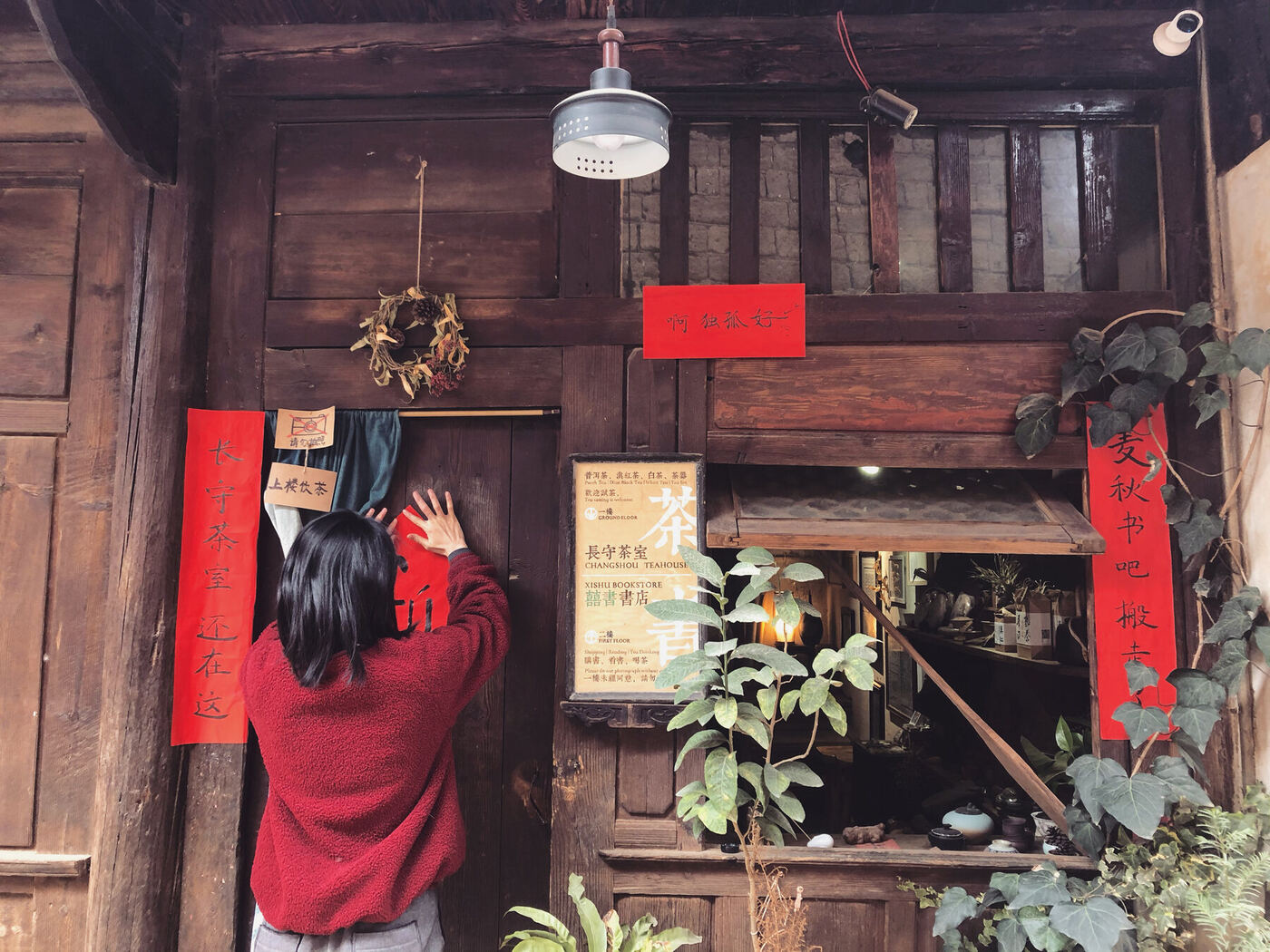
104. The owner of an inn where I once lived is a master sculptor of Buddhist statues. He would stay in temples for months at a time. Once, when he came home, he led me to the central room upstairs, which was filled with small clay figures—studies for larger sculptures. I liked several Buddhas and asked if he would sell them. He shook his head: they were keepsakes. He showed me groups of Bai people at work and said that one day he would make many more, creating something like Along the River During the Qingming Festival, and hold an exhibition. Later he returned to the temple. On another visit home he said, ‘Your sister tells me you have been tutoring our daughter. Take two of those Buddhas.’ I moved Skanda Bodhisattva and the Venerable Ānanda to the newly renovated second floor of Changshou. Near New Year I passed the inn and saw the master and his daughter hanging spring couplets at the courtyard gate.
105. The master walks very softly. He approached without a sound and brought down the incense board. I carried my palm mat before the Buddha and knelt in discipline. By the fourth day I was finally no longer being struck; whenever drowsiness made my head nod, I woke at once. The descending wind from Cangshan hit the glass and shook the whole meditation room. The cushion beneath me felt like a small boat travelling through the universe. Dazed, I forgot who and where I was. Everyone around me seemed to vanish. The master’s voice arrived from the far side of the universe: ‘We come here to resolve birth and death. Birth and death are delusive thoughts. Raise the meditation question; there is no special state. Anyone who tells you there is a state is deceiving you. There is nothing to obtain. Do not discriminate among conditions.’ He continued: ‘A human being should look human. Human birth belongs to the wholesome realms. Beings in the three lower realms have no chance to hear the Dharma. The Dharma is hard to encounter, human birth is hard to obtain, and a true teacher is hard to meet. Since you have come, follow the teaching, listen, and keep the rules. Do not bring your private system in here. People sometimes act like animals, charging ahead, then knowing pain and regret only after the deed is done. Be a rational person.’
106. Negative feelings are seeds of wisdom, so long as we bring awareness to them and do not look with a discriminating mind.
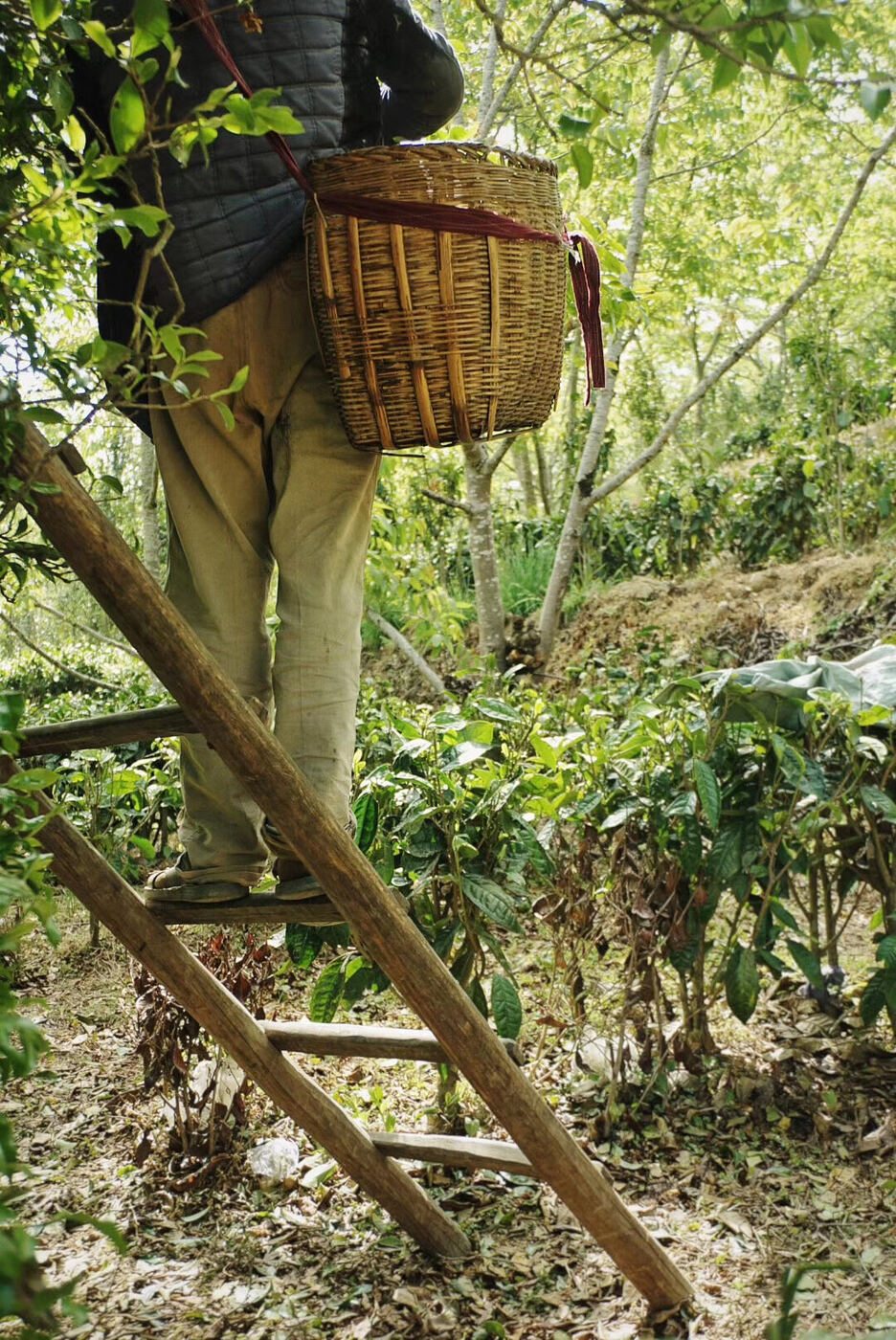
107. Tea was genuinely difficult this year: drought, abnormal weather, and the feeling that people’s immune systems had not recovered after COVID. Yiwu values very fine processing and tiny distinctions among origins, rather like rock tea. The resulting quality varies enormously. It also creates confusion—the sense of a perilous world and unreadable intentions. Jingmai is very different. People there have lived on the mountain for generations. Apart from the two core areas of Dapingzhang and Pa Aileng, villages are not divided into ever finer terroirs; processing and material are relatively even, and there seems to be little internal competition. If one household cannot finish its tea, it lays the leaf out at another. When a village holds a ritual, everyone participates. On Jingmai, collective cooperation seems more important than individual competition. In a Dai village most men share the surname Yan and most women the surname Yu. Most villagers are relatives, and traditions of elders and ritual remain. I did not understand this before. Now I feel Jingmai is a place protected by its ancestors.
108. Thoughts can be more harmful than actions. If we do not examine whether our motives begin in satisfying the self, then whether an act appears good or bad, it still becomes nourishment for the self’s existence.
109. Yogācāra teaches that consciousness—and the speech and action guided by it—creates karma. The seeds of karma are stored in ālaya-vijñāna, the storehouse consciousness. Karma may be unwholesome, wholesome but defiled by self-interest, undefiled wholesome, or neutral. When a seed matures, its result appears. The world seems unfair only because former merit has not yet been exhausted and present karma has not yet ripened. This creates the illusion that honest people are always bullied while improper means bring success without a price. In reality, our thoughts and responses are continuously shaping us. We are continually choosing the environment and fate into which we will enter.
110. At Lanting Yong, Luo Bo said: ‘Today’s talk is about the aesthetics of tea, and I have been wondering what good tea really is. We do not arrive directly at the truth. Drinking tea is like climbing a mountain; only we ourselves know that we are moving forward. I have also realised that what a person experiences as good differs greatly when the body is unhealthy and numb and when it is healthy and aware. But if an aware person finds every tea good, why do we still need good tea or good food? I think it is because good tea and food can more powerfully wake a person from dullness and cultivate awareness. We then carry the attitude we learned through tea and food back into our lives.’
111. I asked the master, ‘Can one attachment really be used to break ten thousand attachments?’ He replied, ‘None of them has been broken.’
112. I asked the master what the kōan of Nanquan killing the cat meant. He said, ‘Things do not need to be reasonable. Then you will not become angry with people.’
113. When we left the tea mountains, Yankǎn’s father picked many plums for us. We said we could not finish so many. ‘Take them,’ he said. ‘In our mountains there are flowers all year, and fruit all year.’
114. Joe asked me, ‘Can someone who loves repairing cars and someone who loves photography understand each other?’ I was silent. He said, ‘If someone reaches thirty or forty and is still absorbed in one thing—games, for example—it means he has no other choice.’ I was silent.
115. ‘It is simple enough: suffering is craving, isn’t it? Craving—whatever the object—brings suffering. Without craving there is no suffering, and everyone knows that.’ —Shantaram.
116. We found a bird that had been struck by a car. Its skull was exposed and a major blood vessel had ruptured. A doctor treated it, took it into surgery, and said he would do his best. Afterwards we placed it in a cardboard box and parked beside the road to eat. When we returned, it had died. Joe and I buried it on Cangshan.
117. In a dream we travelled by plane. Each passenger had a poem assigned to them. Mine read: ‘Fanciful thoughts arise from habitual energy. If you do not wish to rise and fall, clear old karma.’ In dreams I can fly. I went to see penguins, and the penguins lived in high-rise buildings.
118. Luo Bo goes to make pottery every day. I had said for days that I would wake early, but I always overslept. Today she kicked me awake and asked why I had slept so long. I said: ‘I dreamed we were hiking. I could not walk any farther, so I flew over the hills. You asked me to teach you. I taught you to fly along the road, diagonally, and low above the ground. Just as I began teaching you a vertical take-off, you woke me. A vertical take-off is the hardest. I am exhausted.’
119. A silver pheasant appeared in the middle of the road down the mountain. It stood perfectly still and turned its head with composure. Its crest was red; white feathers patterned with black shone like brocade. Through the binoculars every detail was visible. Long white tail feathers trailed like formal dress. Then it stepped calmly to the other side of the slope. We held our breath, sweat running down us, and watched until it disappeared.
120. I dreamed of Xingxing. She lived in a bowl of yoghurt, covered all over in yoghurt, and licked my finger. The doctor said: ‘If you turn on the Wi-Fi, its signal will cover her and she will soon leave us. You cannot take her anywhere with Wi-Fi. You cannot leave this room.’
121. A sentence heard in a dream: behind everything we want comes a particular trouble. Only by releasing the ideas ‘I am’ and ‘I want,’ and opening to a completely unknown world, can we become free.
122. I took a taxi. The driver said his real work was raising pigs and practising veterinary medicine in Baoshan. Before the pandemic, local farmers earned enough to buy luxury cars. During it, most sold their cars to keep the farms alive. Now the price of pork is below the cost of production, while the trade war has raised soybean meal to seventy yuan a sack. At current meat prices he loses four hundred yuan on each pig and expects his farm to lose five hundred thousand this year. When the pandemic began in 2020, he lost everything he had earned from farming. He advised me to buy pet medicines and vaccines on Taobao. An electric car costs one tenth as much to run as a petrol car, he said; choose electric for commuting or commercial work. The master says: worldly affairs are impermanent…
123. I took Oreo to Kunming for treatment. A fierce-looking, heavy-bellied man in leather shoes was bargaining with the doctor. Then he turned away and called his wife. In Kunming dialect he said, ‘Transfer me three hundred yuan. It needs an injection now and I have no money. Three hundred.’ He repeated it once more.
124. Oreo’s smell was foul: mutton, fish, salt, dog musk, faeces, and urine—like a salted duck egg gone bad. It was receiving an injection at the hospital. When I returned to the car, the smell remained, clear and strong. I sat there as helplessness travelled from my hands to my feet. I became like a robot without electricity. At a moment like that, one truly needs a god: someone to blame, to beg, someone onto whom everything can be pushed.
125. I remember seeing auspicious clouds on the first day of last year, then every day until the fifth. I told Goat, ‘This will surely be a good year.’ ‘Really?’ Goat was doubtful. What followed was a year broken apart and battered by storms. In December, Zhao Ni, Xiao Jiang, and Grape came to Shaxi. We agreed to meditate morning and evening. If fragmentation taught us anything, it was that until the final moment we can still guard the mind, remain undistracted, and gather it in one place.
126. Since returning, I have meditated twice on Changshou’s second floor. In the morning I heard rain strike the eaves. People walked below. Their voices and the birds gradually receded with each breath.
129. When we left Wuyi Mountain last year, I saw many passengers on the high-speed train carrying thermos flasks, collecting hot water and brewing tea at their seats. After drinking, they gathered in the corridor to discuss how the tea had tasted. I envied them. This year we brought our own flask and fulfilled the wish to brew tea on the train.
130. Two days ago, the grandmother at our inn asked where we were from. ‘Yunnan.’ ‘Ah, Yunnan is a good place—world countryside.’ In the lift I wondered how she had arrived at such an expression. Then I realised she had said ‘spring in all four seasons,’ not ‘the world is countryside.’
131. I used to believe that only by controlling life through effort could I stop it leaving the rails. Slowly I realised the opposite: the wish to control makes us anxious over gain and loss and unable to release our grip. Letting go is surrender—non-action. We want control because we believe life and things are permanent. Yet all of us will die. Must we control everything until the final moment before recognising that nothing can be controlled? When I released the thought of control, the terrible thing did not happen. Life began to turn by itself.
132. We wanted to build a small shelter in the courtyard for work and shade. Several visits to the municipal office brought one excuse after another; finally they said the problem was its footprint. Furious, I said, ‘Then we will demolish the existing tea room and build two floors. That will not occupy more land.’ The director replied, ‘Two floors are not permitted. Build the shelter. At least it cannot be seen from outside.’ I felt I had become Lu Xun himself.
133. The more teachings I heard, the more I tried to suppress my habits and correct myself with hard principles—and the more those habits struck back. In the end I acquired a stiff, powerless heart, without even enough strength left to suppress. The mind could not move, and the body stopped functioning normally. Often only in the darkest moments did I recognise that every attempt to suppress myself and rule myself by reason was impure awareness: thought passing judgement on my own karmic habits.
134. A distance exists between my real feelings and systematic language. Within it lie my experience of expression and my scrutiny of language and motive. Once I slid into systematised language—applying concepts and playing with elevated words—those precious experiences and that scrutiny disappeared. Expression became performance. If the original motive deviates even slightly, what the reader sees may deviate a very long way.
2025—2026
135. Everyone is trapped in the same mud. When one person finds a way out, they first climb onto the bank, then turn back. They decide to help the others leave. Although they are again standing in the mud, they no longer suffer from it, because they know it can no longer hold them.
136. On the slope back from picking tea, we saw suspicious mushrooms growing from rotten wood: soft, red, translucent, and covered with white bloom. They looked lethally poisonous. ‘Those,’ they told me, ‘are wild wood ears.’
137. We went into the mountains with Pingtou, a twelve-year-old Bulang guide. The car descended into a hollow. We walked through rainforest and followed a river upstream. Rain fell on the return journey, and the car slid on the mountain road and could not climb out. I asked Pingtou whether his father—or people from the village—could come help. He clutched his head. ‘Rather than be scolded by him, I would rather survive in the wilderness.’ Only then did we realise he was simply a twelve-year-old child.
138. Newly fledged swallows sit in the sun to dry and harden their wings. Once the wings are firm, they can fly.
139. As Gogo left Changshou, she said: ‘This cake of tea—Daqing—really is like a full moon. I can place it among the stars, and then it will protect me. Thank you for creating this space.’
140. We lived with Sihe’s family for two days. During the rainy season, villagers leave before dawn to gather mushrooms. Everyone returns with a basket of matsutake or boletes. Potatoes, beans, rapeseed, and morels grow on the mountain. The same crop cannot be planted continuously; after a harvest, something else goes into the field the next year. Besides leading student hikes, Sihe and his elder brother prepare three meals and cook over fires in the mountains. One afternoon a chick fell from its nest. The mother circled anxiously while the brother borrowed a ladder and replaced it beneath the eaves. That evening we sat around the stove, watching television and drinking tea.
141. On the final day of the Mapingguan programme, the teachers shared their reflections. I said that the children knew the place where they lived: its crops, weather, mountains, and soil. They knew what their lives were made of and how to continue living. Human wholeness had not yet been taken from them. They understood their surroundings, participated deeply in their community, produced things, and benefited from that production. Almost no link in the chain had to be handed to someone else. They did not need the extreme division of labour celebrated by contemporary society. Every household could build a house, keep bees, lease a mountain and gather mushrooms, and bear its own gains and losses. The result was already contained within the act. By contrast, a modern life governed by abstract ideas and standards of value more easily produces spiritual emptiness. The children of Mapingguan seemed more whole than I was, and closer to the natural condition of a human being.
142. Some people misunderstand existentialism as the nihilistic claim that life has no meaning and therefore may be spent arbitrarily. True non-action requires deep concentration, wisdom, and awareness. That distinguishes it from ‘lying flat’ or giving up. Someone who watches television at home for three years may still wake at midnight clutching their chest and asking, ‘What have I been doing?’ The voices of parents, society, and peers have been internalised as a whip. They remain at the subconscious level, generating anxiety. If those prior demands cannot be loosened, the outward form of life makes little difference. Passive inaction without awareness merely escapes one discomfort and falls into another. Non-action means taking responsibility for one’s choices: a settled condition that is not disturbed from outside and turns around a clear, stable centre. Only in a present moment of full awareness and clarity can we understand that everything gained by chasing outward is impermanent—and that there is nothing worth chasing.
143. A friend brought back a bed of nails, like an acupressure board. Standing barefoot on its points sends pain from the soles to the crown of the head. The longer you stand, the more clearly you feel the separation between body and pain, and observe how the brain responds to the body’s signal. Luo Bo had a view: ‘If someone makes you suffer, leave them—just as you step off a board that hurts. You do not resent the board or stand there cursing it. Even while you are on it, you recognise that pain is pain and you are you. If pain remains in your feet after you step down, you have a chance to observe it. You notice that the feet that stood on the board are more sensitive, and you become curious about your body. Why can we not do this with people? When someone hurts us, we sink into resentment, numb judgement, hatred, and discomfort, stirring every feeling into confusion. Disliking the person becomes an excuse that covers our own experience. Perhaps people resemble each other too closely while objects are too different. It is hard to project ourselves onto an object, but easy to do so onto another person.’
144. After New Year we visited young Master Yang. I had not seen him for a year. He looked older, with more wrinkles. Work had been scarce and money difficult, he said. Embarrassed, I apologised that the courtyard project we had asked him to do had earned him so little. ‘Ah, do not say that.’ While working at Jizu Mountain, a lay Buddhist gave him a radio of Chinese classics and taught him to listen. For the past twenty or thirty years, the man said, everyone pursued the economy. Now the economy was bad, people should pursue merit. Things that once seemed like losses could be understood as merit stored for the future. If everything were spent now, nothing would remain. So whether someone offered him one hundred or two hundred yuan, once he agreed, he worked carefully. Then Master Yang changed the subject: ‘All these years, it seems you have read too many books. Your head looks muddled. Perhaps you need not read so much. Go outdoors and walk.’ We looked at each other and laughed. Yesterday Zu told me that empathising with others also means allowing oneself to be hurt. A bodhisattva who jumps into the mud to save people cannot keep their clothes clean.
145. A friend came by and said she had spent the morning digging a cartload of cow manure for the fields. Cow manure does not smell bad; it carries a faint fragrance of grass. Sheep manure is even better, though locals usually reserve it for flowers. They planned to grow Wuchang rice but had never tried it and did not know whether it would take. Local farmers follow the solar terms strictly: raise seedlings at Awakening of Insects and transplant at Qingming, or it will be inauspicious. ‘Where shall we go in spring?’ she then asked. ‘Aren’t you farming?’ we replied. ‘The auntie can handle it. If we transplant rice, we only get in the way—our feet stick in the mud and everyone laughs.’ About a week ago, spring arrived. Warm, damp wind blew from the southeast. A few small flowers opened on the cherry tree at night, and fragrance filled the air. The spring wind carried an encouraging force of growth.
146. While practising tai chi I met the street sweeper. She said she was resigning the next day; this was her last shift. She had cleaned here since 2019, six and a half years. Her son and daughter-in-law went to Eryuan for work because they earned more than she did. Their daughter was just over one hundred days old, so she would stay home and care for her. Her husband ran the rubbish depot and earned 3,600 yuan a month. She rose before dawn and worked until dark for 1,800, so everyone urged her to quit. But she loved sweeping. She loved the bustle around Yujin Bridge. When she saw us practising tai chi, she sometimes wanted to join. There was no choice, she said. When her granddaughter grew older, she would bring her back to the bridge. She walked away reluctantly. ‘How cool,’ Luo Bo said. ‘I have never heard anyone say they love sweeping.’ I hope I can love sweeping too. Perhaps there are things like that I already love and have not yet discovered.
147. Luo Bo and I went to a music festival in Kunming. Deserts Chang wrote a letter to Cao Fang; this performance’s set list was for the friends who had continued writing songs together through the past twenty or thirty years. Cao Fang came onstage with a flower in her pocket, picked for her that morning by a friend. I felt the way they cherished and cared for one another. The weather shifted between sun and rain all day. By night the rain was heavier. ‘I will stand here and be rained on with you,’ Deserts said. ‘I will not retreat.’ At the end almost every worker and musician had left, but she remained onstage watching the fireworks with everyone. She kept waving until the barrier rose. At last only one hand could be seen above it, still waving. One person’s love can be wide and the self very small, able to hold so many strangers sincerely in the heart.
148. Since Wang Bo moved to Kunming, we seldom meet. Yesterday we played football. The opposing forward was a former China League One professional. One glance at the goal and he could send the ball precisely to any angle he chose, at such speed that it brushed above my head before I could react. We blocked him twice: once Wang Bo read his route and slid across to stop the shot with his shin; once the ball glanced off Wang Bo, slowed, changed direction, and I saved it. In the final game the player exerted himself slightly and beat us 3–0. Drinking tea at Wang Bo’s home, we talked about having children. ‘I remember something you once said,’ he told me. ‘Because nobody is ready, there is no need to worry.’
149. I wanted to grow vegetables, so I borrowed one square metre of a friend’s plot. At market I bought a bundle of cabbage seedlings and a bundle of chillies for five yuan, their roots wrapped in leaves. I met Zhang Wei, who said that one yam seedling could produce an entire basket. I was tempted. At the plot my friend taught me to turn the soil, remove the fleshy grubs that ate roots, and throw them beside the road. Sparrows soon gathered and carried them away. Once turned, the soil was raised into ridges so summer water could drain and the vegetables would not drown. After planting the cabbages, I saw no space remained, so I pushed all the chilli seedlings into one clump. My friend came over. ‘Chillies are not the same as cabbage. You can plant them closer—three at a time. Just try. Practice brings true knowledge.’ I fetched water from the roadside drain and soaked the earth. As I left, my friend laughed: ‘Now you have to come and water them every day.’ Although it was only one square metre, I returned tired and stared into space for half an hour. When I talk too much, I begin not to trust language. Farming returns me to action and intuition and lets thought and feeling rest.
150. I repeatedly dream of sitting entrance examinations. Perhaps I wanted so much to meet my mother’s expectations that I never reconciled myself to leaving university. Examinations, higher degrees, more labels and knowledge formed an inner critic that kept pressing me. In dreams I return to school again and again. Although I am over thirty, I must sit exams as a high-school student—like the lyric by Omnipotent Youth Society: ‘Silently watching the classroom you cannot leave.’ I am trapped there, returning a hundred or two hundred times, always waiting for the test and hoping that this time I will really graduate with proof worthy of my mother. Usually I wake before the exam, while its pressure and waiting anxiety remain in my body. Recently the dreams have changed. First, I dreamed I was organising a class meeting. I no longer worried about exams and instead planned what everyone would perform at graduation. Next, I dreamed Luo Bo and I prepared together. She was certain to enter university, while I still seemed unlikely to pass. The third continued the second. On the eve of the national exam, an art-school teacher inspected our work. Seeing my paintings, he said, ‘You paint very well. Apply through our independent admission, and you will not need to sit the national exam.’ It was as though he confirmed that even an outsider like me could be recognised and become useful if placed where I belonged. I was admitted early to the teachers’ university art academy. Luo Bo sat the national exam and earned an excellent result. In the dream, we both had bright futures.
151. Plants possess no knowledge about plants, yet they know how to grow.
152. After Xingxing and Oreo died, one cat and one dog remained: Beidou and Guozi. One day Master Yuanshi came to the house and told them, ‘Take refuge in the Buddha, the Dharma, and the Sangha. Good—now you too are disciples of the Buddha.’ Guozi’s health is poor. His front legs developed badly and turn outward. Sometimes he has skin allergies. Once, running in the mountains, he tore his cruciate ligament. Surgery left a titanium plate in his leg and changed the way his hindquarters bear weight. We had just bought a car on credit and had little money. We had debated paying for four-wheel drive but chose front-wheel drive. Guozi’s operation cost more than ten thousand yuan, and the surgeon came by high-speed train from Kunming. After deciding to proceed, we sat silently in the car. Luo Bo asked, ‘Would ten thousand be enough to convert our car to four-wheel drive?’ ‘No,’ I said, ‘but it can convert Guozi to four-wheel drive.’ She laughed through her tears. The operation succeeded. Guozi often meditates with us now. As a joke we call him Zhengguo—‘right fruit.’ Beidou becomes Zhengbei—‘true north.’ Beidou seems to have ADHD. He cannot stay beside a person, spends a few minutes everywhere before moving on, dislikes control, and usually lounges alone. Sometimes he returns from a fight dejected for several days, then forgets completely. Sometimes enemies visit and leave fur and urine around the house. Once Xingxing disappeared. At five in the morning I walked through Nanguzong Lane calling her name. A grey street cat appeared, looked at me, and meowed softly. It led me forward, turning every few steps to look back, until we reached the inn where Xingxing was trapped. One or two cats crouched outside, staring curiously at Xingxing behind the glass lattice as she scratched and screamed. We guessed that she had hidden while playing inside, then the innkeepers returned and locked the door. Finding herself confined to the tiny lobby, she panicked. That was the first time I entered the world of cats; for a moment it seemed that communication passed between us. Cats at night are intensely spiritual creatures, speaking through eyes, scent, and silent pheromones. The cat that led me to Xingxing stayed nearby while Luo Bo used a treat to coax her down from the roof. Thank you, cats. Text: Gu Rui. Images: Gu Rui and Luo Bo. Original edit: Luo Bo.