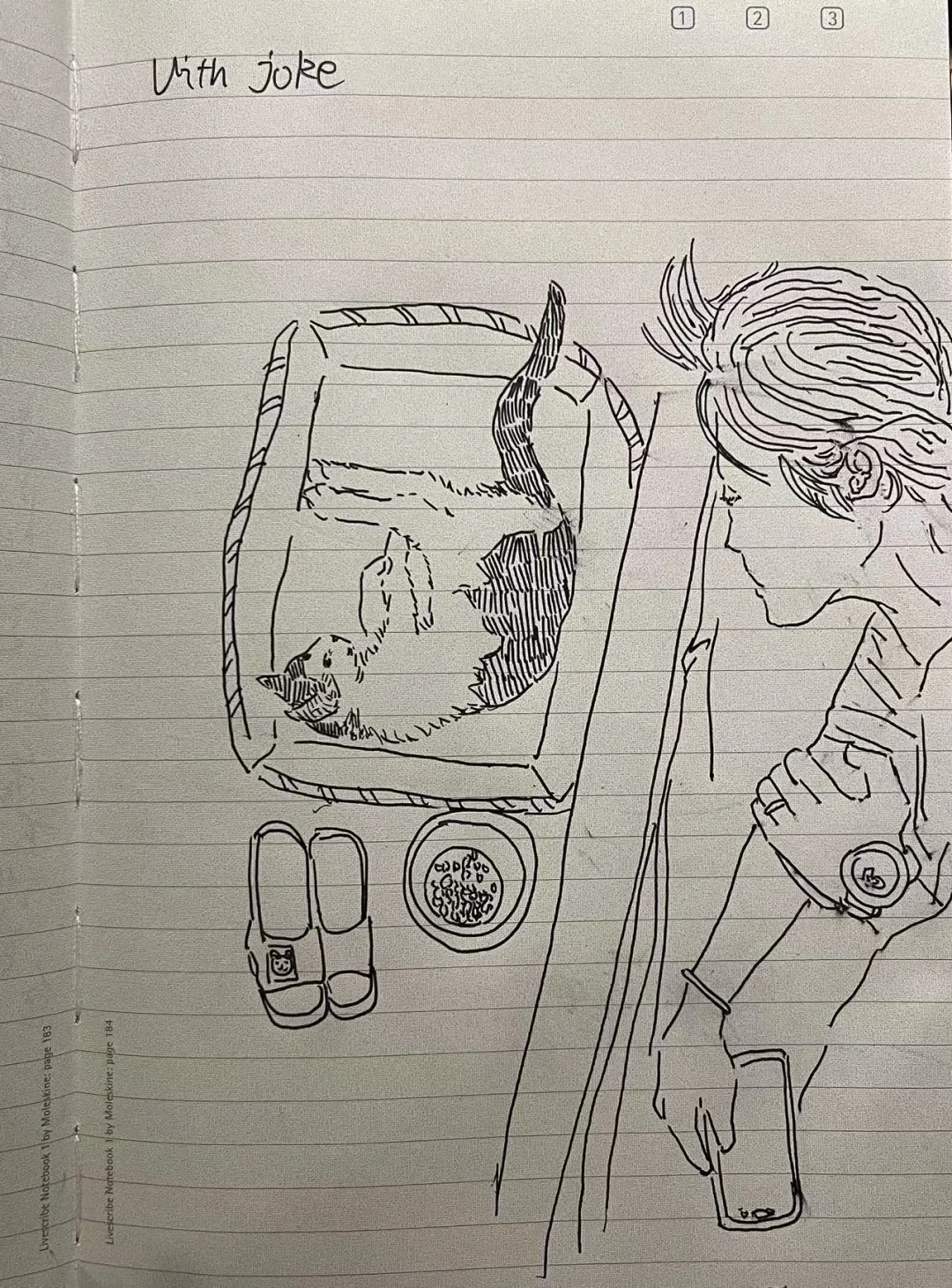
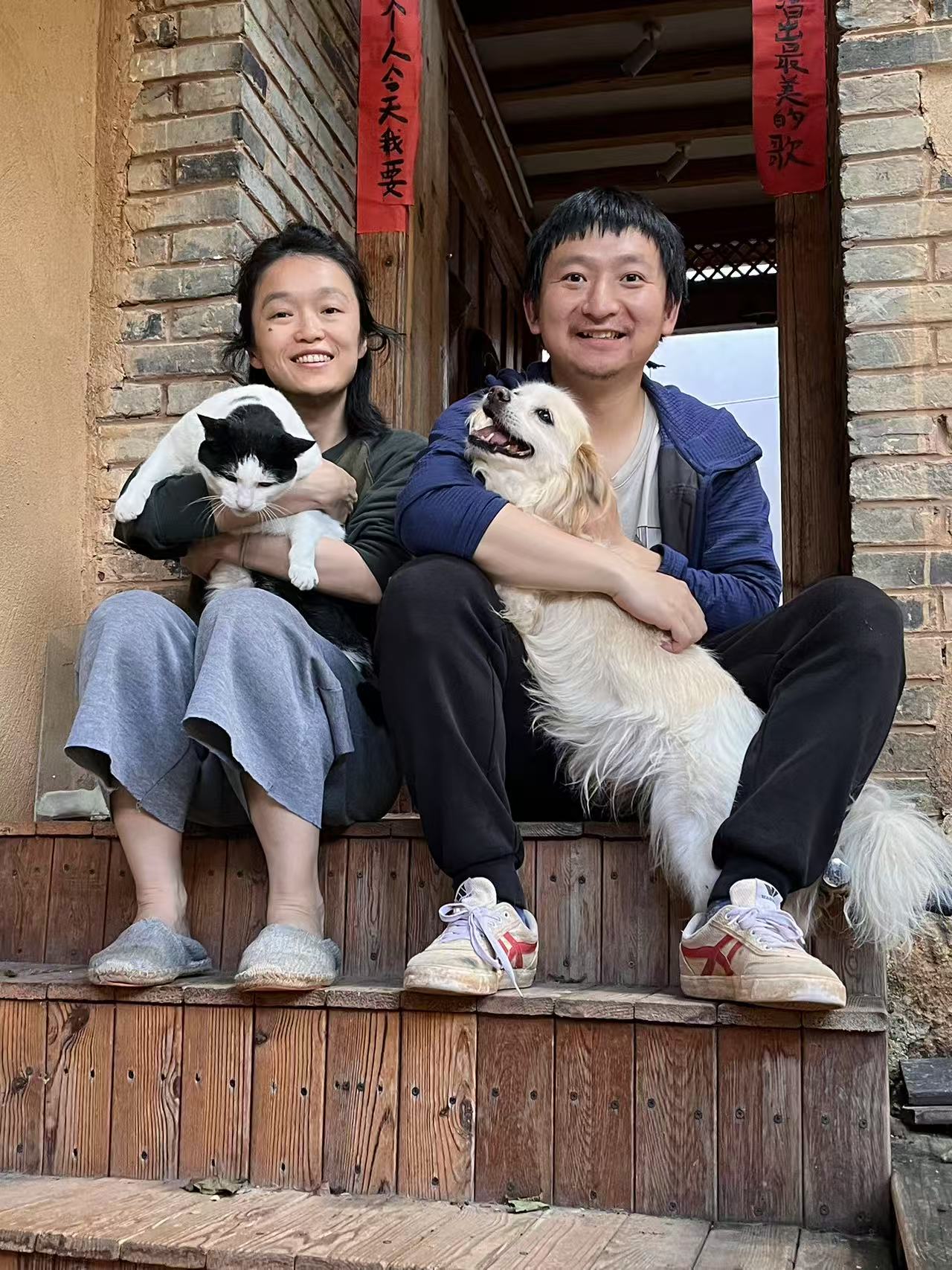
A complete English translation of Changshou’s original journal, written in memory of Xingxing.
1. Three kittens
While we were taking Xingxing back and forth to hospital, I was reading Platero and I. Jiménez wrote a book for a little donkey called Platero. If I could, I wanted to write something for Xingxing too.
Three springs earlier, while I was making tea in the mountains, Luo Bo and a friend found three kittens beside the road. She called on video and showed me the animals in her arms. I worried: We cannot keep cats, can we? We already had three dogs, all former strays from town. Feeding and walking them was enough. Tea-making already seemed impossibly difficult then; everything felt like a burden and freedom felt very far away.
We agreed to raise the kittens on goat’s milk and then find homes. All three were black and white, distinguished by the markings on their foreheads. Beidou had a centre part, Dahe a short fringe, and Xingxing a side-swept fringe. Xingxing and Dahe had marks on their noses; Beidou did not. The two boys were bigger. Xingxing was the thin little sister. Luo Bo doubted she would survive winter and slept beside her.
Our mattress was still on the floor while we waited for a carpenter to make a frame. The kittens tottered around it, unable even to climb the bathroom step. If one wet the bed, Luo Bo washed the entire set of sheets. Their names came from the opening of the Song of Heroes: ‘The great river flows east; the stars in the sky follow the Big Dipper’—Dahe, Xingxing, Beidou.
A girl in town, Wang Yuyan, had placed the box on the street. Their mother, a large white cat, had given birth above her family’s animal shed and disappeared. Yuyan hoped the mother would carry them away. Instead of their mother, they waited for Luo Bo.
When I returned, we interviewed a prospective adopter for Beidou at the tea room. A Mongolian man who kept sheep and made cheese said he studied Daoism: he would not neuter or confine the cat, but let nature take its course in the village. We paused and told him to wait for news. ‘Why does this feel like a job interview?’ he asked. We could not accept that version of following nature.
Another adopter lived two hours away in Lijiang. Just before she left to collect Xingxing, Luo Bo said it was too far—what if we missed her? A third wanted all three only to catch mice at his guesthouse, and never came to meet them. So we kept every kitten. For a while we had three cats, three dogs, and a courtyard under renovation. Later Dahe escaped through a demolished wall and never returned. After searching again and again, Luo Bo said, ‘The great river has flowed east.’
2. Xingxing’s intelligence
After they were neutered, Xingxing remained noticeably smaller. Dahe grew big and foolish, once scorching his fur by the winter fire without noticing. Beidou felt safe with everybody and distributed his affection skilfully among our guests. Xingxing was plainly clever. Although she ate little, she opened the latched food bins for her brothers—and sometimes the dog-food bin too.
One night we heard a repeated thumping and thought fireworks were sounding by the river. We had forgotten to refill the automatic water fountain. Xingxing was rocking it so the last water in the base rose into reach, allowing her brothers to lick it. Again and again she tipped and served, like a canteen auntie ladling lunch for students.
‘Her intelligence has a sense of justice,’ Luo Bo said. ‘She uses it for everyone’s good. She is neither stupid like her brothers nor faintly disreputable like the dogs.’ Xingxing would not drink directly. She dipped a paw, then licked it, elegant enough that Luo Bo wondered whether she had once been human.
As kittens they went outside, and Xingxing became lost twice. Strange places overwhelmed her; she seemed to forget who she was and could not return. We tried tarot and an internet method involving a bowl of water, scissors pointing in the direction she had gone, and an appeal to the Kitchen God. After three days, Luo Bo’s brother found her crying on a roof. She did not recognise us and leapt from Luo Bo’s arms, but once inside the house she became calm—as if every memory had returned at once.
The second time, I searched all night across Shaxi’s connected roofs, the higher-dimensional space of cats: waves of tile above streets and walls, with only the birds’ sky beyond. At six in the morning, a little grey cat saw me, called, walked ahead, and kept turning to check that I followed. He led me to a guesthouse where Xingxing cried behind a wooden lattice door. At dawn Luo Bo coaxed her from the roof with a treat while the grey cat watched. After that—and after losing Dahe—we kept Xingxing and Beidou inside the courtyard. Beidou grew to three times her size. A visitor pointed to him and asked, ‘Is that the other cat’s mother?’ ‘Every part is wrong,’ Luo Bo replied.
3. Doors, films, and a quiet room
New environments always distressed Xingxing. After a vaccination trip to Dali she vomited and had diarrhoea, and stayed in hospital longer than her brothers, though a full examination found her healthy. Spaying left her limp as if boneless, with small crawling stitches across her belly. Females, whether animal or human, always seem to suffer more.
Once recovered, she learned door handles. She jumped, hung from a lever, and the door opened. Against handleless magnetic doors she braced herself and kicked away like a swimmer at the start of a race. The wooden panel opened before her like the Red Sea. She led her brothers from room to room, slept in empty beds, hid beneath quilts, and avoided strangers in wardrobes or high roof beams.
When we were away we watched the animals on a camera. Xingxing followed its turning eye. If we spoke through the little white machine, she discovered the source and slapped it face-down. On the screen she sat like a ceramic cat, head tilted at the surrounding world.
Our bedroom held many toy elephants, which she dragged beneath the bed. Luo Bo gradually felt that Xingxing resembled her: intelligent, sensitive, and powerfully empathetic. During arguments Xingxing climbed into Luo Bo’s lap and gently covered her mouth with a paw. She disliked noise, dirt, dogs, and Beidou rushing about. She liked quiet, solitude, meditating with me, and watching Abbas Kiarostami’s 24 Frames. Beidou fell asleep; she watched intently, then sprang at a bird moving across the snowy screen.
4. Illness
Xingxing often became ill. Stress brought vomiting, diarrhoea, and long refusals to eat, followed by hospital drips. When we replaced her food with a more expensive, nutritious brand, she missed the flavour of the old one and starved herself until her digestive tract bled. Her coat dulled and clumped. She crouched like a hen with half-closed eyes—a posture Luo Bo said showed pain.
Returning to the old food restored her for a while. She became plump enough for a double chin, came early into the courtyard, stretched on sun-warmed stone, and rolled in the light. Watching her relax allowed us to relax too.
After we returned from making tea the next spring, she was thin again, without appetite, with brown crust at the corners of her mouth. The diagnosis was stomatitis: her immune system was attacking her teeth, making swallowing painful. Antibiotics helped only briefly. The doctor said extraction was the eventual answer, but she seemed too weak for it.
By the third year she drooled constantly and had little energy. One experienced doctor advised against extraction: teeth are important tools, and some cases continued after removal. The vet who had known Xingxing since kittenhood argued that pain already kept her from chewing—without those teeth, she could finally eat. Her anaemia came from chronic inflammation and hunger. We chose the operation.
Anaesthetic made her collapse once more. I told her we were not harming her; when the teeth were gone, the pain would be too. The surgeon laid her molars before me. Two had broken during extraction and their roots took a long time to clear. Her canines remained because they did not cause the inflammation. Sweating after the difficult procedure, the doctor apologetically asked for an extra hundred yuan.
5. A little recovery
Around then our friend Xiaobai’s cat, Taoge, fell from a second floor at night and died. Xiaobai left food, medicine, and a scratching board outside our door: ‘The house has no cat now. None of this can be used.’
After two days of drips, Xingxing progressed from treats and tinned food to softened kibble, then dry food. Her nose, mouth, and paw pads were pale, but she ate four or five times a day. Where her molars had been were black holes; without pain, she could swallow.
She joined us for tea and meditation. Even with stomatitis she had liked tea water and mint leaves from the courtyard, and the habit remained. Her body opened into relaxed postures, though tears ran from one eye. I teased her: perhaps she was moved because the pain had gone, her appetite had returned, and a happy life was about to begin.
Her digestion seemed normal. Luo Bo fed her separately so Beidou could not steal her food, and kept her in our room at night. During the day she hid beneath a pale-yellow curtain in a guest room, gathering sunlight until her white fur opened like a dandelion. Yet she began urinating in strange corners. One morning a robot vacuum dragged faeces across the study before jamming. I disinfected the loft floor and shelves.
That afternoon she collapsed. Her breathing raced; ears, nose, and mouth were white. Tests in Dali found dangerously few red blood cells and platelets. A transfusion was best, but the clinic had no donor. When the doctor began consulting veterinary books mid-examination, I understood that Xingxing’s condition exceeded his experience.
6. The last journey home
At home she lay like a rag doll. Every twenty minutes Luo Bo turned to see whether her belly still rose. The next day another hospital had an eight-kilogram orange cat who might donate. Against the odds both cats had type A blood. After a saline test, Xingxing suddenly gasped, rolled in the cage, and foamed at the mouth. Blood from the donor eased her. Her head lay on Luo Bo’s arm above an electric blanket. Her body grew warm and I thought she was improving, but it was only the blanket’s heat.
The donor gave ninety millilitres and still bounced about after nutritional paste and tinned food. At home Luo Bo blended chicken liver, kibble, paste, and warm water, froze a supply of liver, and fed Xingxing by syringe. ‘I am not trying to make you suffer,’ she said. ‘I want your body to recover. The only thing I ask is that you eat.’ But Xingxing no longer had strength to digest. She gasped, could not reach the toilet, and wet herself. She kept trying to hide beneath the bed or in the wardrobe, away from the heater and cushions we arranged.
One night she suddenly jumped onto the bed and lay between us. Half awake, I thought it a dream. ‘Xingxing is better,’ I said. She walked to the bathroom and the clear sound of her urinating let me sleep. In my dream I met Chögyam Trungpa outside a library and told him I had read two of his books and meant to read a third. ‘Is that so? Good,’ he said.
Every method we believed might save her seemed also to add pain. Food made her swollen and sick. A doctor suspected immune-mediated haemolytic anaemia: her immune system destroying her own red cells. Chronic anaemia had already harmed her organs. He could offer steroids and protection for the digestive tract, but not an answer when we asked whether to keep feeding her and returning to hospital. We wanted her to suffer less if she could not recover.
My veterinarian friend Emma in New Zealand said no doctor could make the decision for us. We knew Xingxing best; if her condition was truly terrible, ending treatment deserved serious consideration. We took a week’s medicine to inject at home and drove back to Shaxi instead of putting her through the journey each day.
It was my birthday and the fifteenth day of the lunar month. A vast, white full moon rose east of Erhai through the mountain folds. Death circled close above us. Xingxing stretched like dough inside the cage on the back seat, sometimes so still we thought she had gone, until we saw the slight lift of her belly. The dark motorway fell behind; signs flashed and disappeared. She had loved 24 Frames, and we still hoped to watch it with her once more.
7. Two blessings
After Xingxing died I had two dreams. In the first I kept slicing apples, trying to prove that one cut through the core tasted more bitter. In the second we found another missing tea-room cat in hospital. When I returned, Xingxing leapt healthily from one table to another. I told myself: she has died, so she will never be ill again. She is healthy.
Luo Bo thought of Xingxing while eating grilled tofu, which swells then falls, swells then falls, like the final movement of her belly. Xingxing came home to Shaxi and died in the courtyard. Beidou watched and licked her fur, apparently without a concept of death. Her breathing became rapid; she turned twice, then stretched her forelegs hard, as if trying to draw her spirit from the body. Her pupils widened. She grew cold and rigid.
That evening we meditated together for the last time and recited sutras for her passage. Back in the room I saw Xingxing’s bowl and realised Luo Bo would soon see it too, so I carried it away.
The next morning we buried her at Shibaoshan. Pale blue morning cracked like thin ice. The hoe struck the soil again and again. Sun rose; clouds changed shape overhead. Her grave is on a sunny slope. Climb the boulder above it and Shaxi comes into view. Luo Bo asked me to point out the direction of our home so Xingxing would know the way. Before leaving, we asked the guardian deities and ancestral spirits of Shibaoshan to receive and protect her.
In the nights just after her teeth were removed, while I worked downstairs, Luo Bo would feed her and Xingxing would leap into her arms. However awkward Luo Bo’s posture, she slept there with her.
As Xingxing was dying, Luo Bo told her, ‘Come and see us often.’ I said, ‘Do not come back. I hear Amitabha’s Pure Land is beautiful. Go there and do not suffer again.’ Luo Bo answered: ‘You have your blessing, and I have mine.’
5 November 2023.